Description
Rural areas in the EU represent 83 % of its total area, housing nearly one third of the EU population. Nature and human society in rural areas have co-existed for thousands of years, offering unique examples of heritage. As such, rural areas need to be safeguarded against potential economic, social and environmental threats but also recognised as communities of sustainable development and growth.
A hub for heritage-led regeneration
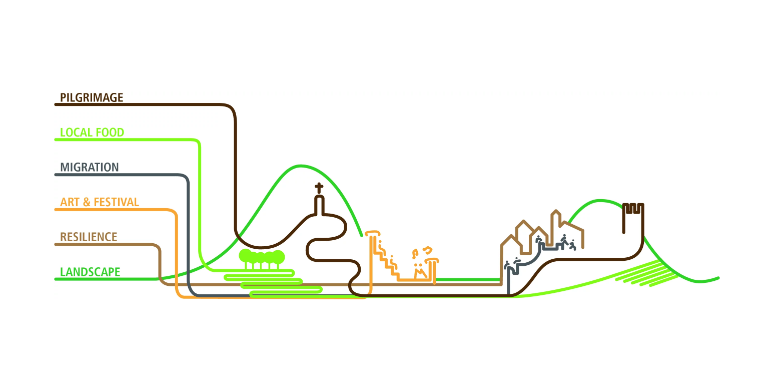
The project set out to identify the unique natural and cultural heritage potential of certain rural areas and use them as an engine for regeneration. Towards this goal, the consortium developed the Systemic Innovation Areas framework: pilgrimage, resilience, sustainable local food production, integrated landscape management, migration, and art and festivals. Throughout the RURITAGE project, 13 rural areas were selected as ‘Role Models’, including the Asti Province in Italy, the town of Visegrád in Hungary and the island of Lesvos in Greece. These rural areas served as examples where regeneration took place with the help of cultural and natural heritage. The Role Models were selected in reference to the six different Systemic Innovation Areas. Prosperous practices of the Role Models were analysed and furthermore transferred to six selected ‘Replicator’ areas. Replicators are rural communities wishing to build their own heritage-led regeneration strategies but lacked relevant skills, knowledge, and capacity building.
Each Role Model and Replicator established a so-called ‘Rural Heritage Hub’ (RHH) of local stakeholders as a meeting place for sharing knowledge and skills. “RHHs served as living labs where local stakeholders and inhabitants cooperated to develop new heritage-led regeneration strategies for their territory,” explains project coordinator Simona Tondelli. A participatory planning process ensured that the Role Models’ experience was tailored and adapted to the specific needs and challenges faced by Replicators. These community-driven hubs (physical and digital) remain active even after the completion of the RURITAGE project, creating a strong network that will continue to foster the heritage paradigm as a driver for regeneration.
Webpage
Status
ClosedJun-01, 2018 to Aug 31, 2022
Socio-economic significance
The project involved over 3 440 citizens in the RHHs, restored or retrofitted 39 buildings, made more accessible 6 sites and 230 km of cultural routes, improved 550 kilometres of cycling/walking routes and organised 66 festivals and art exhibitions. RURITAGE also improved the Wi-Fi coverage by introducing 65 new hot spots and organised webinars attended by over 2 680 people. To secure the sustainability of the project, and that all good outcomes are put to good use, the consortium set up a ‘Resources Ecosystem’ hub. The digital tools are open access to all and will continue to support local communities to regenerate with the RURITAGE methodology and monitor results for sustained growth.
Results
A digital hub for rural regeneration to promote knowledge sharing, mutual learning & collaboration within rural communities and beyond
- ATLAS: is an interactive tool where users can navigate through RURITAGE territories, learn about the region’s cultural and natural heritage and find out how they have been implementing regeneration processes.
- RURITAGE Decision Support System (DSS) is a system for supporting the discovery and composition of possible heritage-led regeneration scenarios, which considers previous initiatives and provides suggestions for combining good practices and Lessons Learnt from various Role Models, allowing the choice of comprehensive programmes to be implemented at replicating sites.
- RURITAGE Replication Toolbox The My Cult-Rural Toolkit focus on three handmade participatory research tools that use local and raw materials to co-create temporary installations outside. During the co-creation, each tool creates discussion and once made, the installations are recorded using visual and qualitative recording methods. Tools 4-5 are mobile phone application (app) that are free to download and allow text and images to be collected and georeferenced using smartphones or tablets.
- Monitoring Platform! Examine the evidence of the role of cultural and natural heritage in rural areas as a driver for sustainable growth. Regeneration initiatives are monitored in terms of their performance through cross-thematic and multiscale Key Performance Indicators (KPIs). The Monitoring Platform shows a variety of dashboards from global performance values to detailed KPI data visualized through spider or radar charts and data tables.
Funding Source
(EU) Horizon Europe
Funding Programme
EU, H2020, H2020-EU.3.5. - SOCIETAL CHALLENGES - Climate action, Environment, Resource Efficiency and Raw Materials, SC5-21-2016-2017:https://cordis.europa.eu/project/id/776465
ERUA Regions
North Aegean (EL41), Île de France (FR10), Freiburg (DE13)ERUA Stakeholders
ICLEI European Secretariat GmbH, Natural History Museum of the Lesvos Petrified Forest, UNESCORole
Partner
Topic
Cultural heritage as a driver for sustainable growth
Countries
Consortium
39 Partners: UNIVERSITA DI BOLOGNA(Coordinator), AGENZIA PER LA PROMOZIONE DELLA RICERCA EUROPEA,POLITECNICO DI TORINO, BORGHI ITALIA TOUR NETWORK SRL,DISTRETTO AGROALIMENTARE REGIONALE SCRL,PIAM ONLUS ASTI,COMUNE DI APPIGNANO DEL TRONTO (Italy) ,CONSULTA EUROPA PROJECTS AND INNOVATION SLFUNDACION TECNALIA RESEARCH & INNOVATION, FUNDACION CARTIF, FUNDACION SANTA MARIA LA REAL DEL PATRIMONIO HISTORICO,CLUSTER DE HABITAT EFICIENTE (Spain), UNITED NATIONS EDUCATIONAL SCIENTIFIC AND CULTURAL ORGANIZATION, RESEAU CHEMINS DE SAINT-JACQUES DE COMPOSTELLE,CA PROVENCE-ALPES-AGGLOMERATION (France), UNIVERSITY OF PLYMOUTH, TAKE ART LIMITED (United Kingdom), ICLEI EUROPEAN SECRETARIAT GMBH, GEO NATURPARK BERGSTRASSE-ODENWALD EV (Germany), SAVONIA-AMMATTIKORKEAKOULU OY (Finland), NORGES MILJO-OG BIOVITENSKAPLIGE UNIVERSITET, MAGMA GEOPARK AS (Norway),STOWARZYSZENIE CENTRUM ROZWIAZAN SYSTEMOWYCH
(Poland), INNOVATION AND MANAGEMENT CENTRE LIMITED (Ireland), ALMENDE BV,
(Netherlands), FEDERACION COLOMBIANA DE MUNICIPIOS (Colombia), VISEGRAD VAROS ONKORMANYZATA, EMI EPITESUGYI MINOSEGELLENORZO INNOVACIOS NONPROFIT KFT (Hungary), KULTURNO IZOBRAZEVALNO DRUSTVO KIBLA,ZAVOD ZA KULTURO, TURIZEM IN PROMOCIJO GORNJA RADGONA (Slovenia), MOUSEIO FISIKIS ISTORIAS APOLITHOMENOU DASOUS LESVOU,PANEPISTIMIO KRITIS (Greece), KATLA JAROVANGUR SES(Iceland), JUDETUL HARGHITA, ASOCIATIA INSTITUTIO PRO EDUCATIONEM TRANSILVANIENSIS (Romania),
ARBEITSGEMEINSCHAFT GEOPARK KARAWANKEN-KARAVANKE (Austria), IZMIR BUYUKSEHIR BELEDIYESI, DE SURDURULEBILIR ENERJI VE INSAAT SANAYI TICARET LIMITED SIRKETI,IZMIR INSTITUTE OF TECHNOLOGY(Turkey)